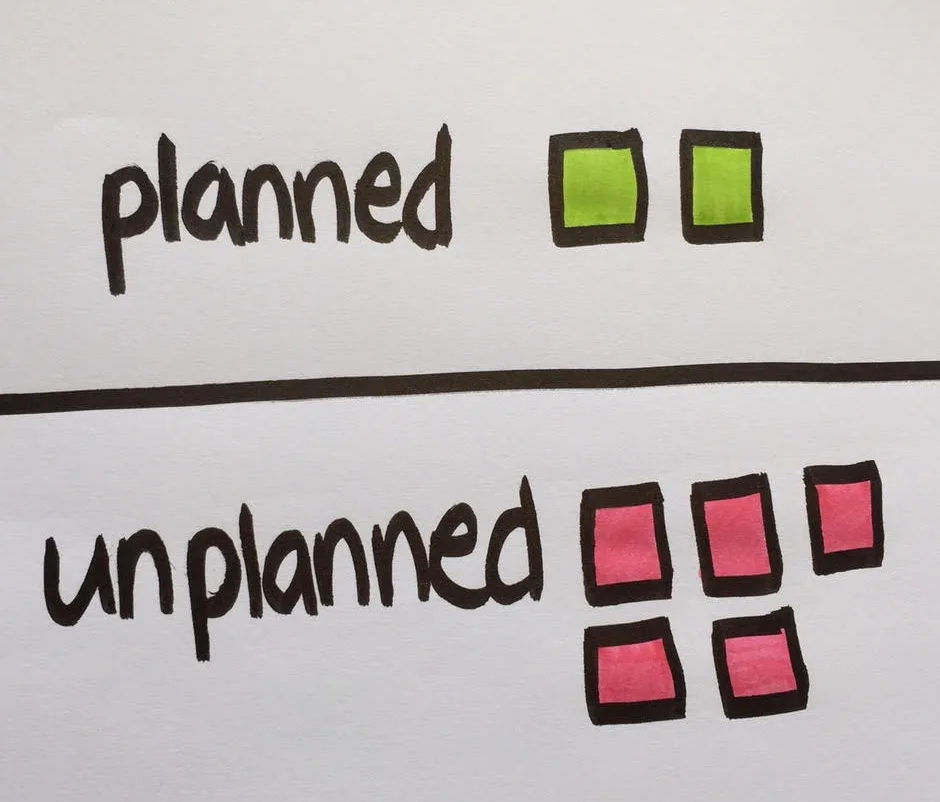
Unplanned work — firefighting — is reactive, expensive, and steals time from the planned work that actually moves the business forward.
Like most people, you probably start each morning with a plan. Then urgent items pop up at random and your day turns chaotic. You fall behind, rush everything, and miss deadlines. That's not a personal discipline problem — it's an operational signal your organization should take seriously.
At a glance
- Planned work is proactive with a known cost; unplanned work is reactive and comes at the expense of planned work
- Three or more chronic symptoms (from HBR research on firefighting) mean firefighting is systemic, not occasional
- Six practical responses: list, prioritize, delegate, automate, align to business goals, document
- Unplanned work never disappears entirely — but you can reduce it and make it visible
Planned vs. unplanned work
Planned work is proactive. Goals are clear, tasks defined, effort estimated. You know the cost before you start.
Unplanned work is reactive. It happens at the expense of planned work. When you spend all day firefighting, there's little energy left for planning — and planning always beats reacting.
| Type | Characteristic | Effect on capacity |
|---|---|---|
| Planned | Clear goals, estimated effort | Creates durable value |
| Unplanned | Urgent, interrupt-driven | Consumes your best people's time and energy |
At a Montreal fintech where I worked, we started by measuring how many hours per week vanished into "emergencies" before talking about tools. The number — nearly 30% of an eight-person team's capacity — changed the conversation with leadership. Without that visibility, everyone assumed it was "normal."
Are you firefighting?
In a well-known HBR piece, firefighting is best characterized as a collection of symptoms. You're likely in firefighting mode when at least three of these show up repeatedly:
- There isn't enough time to solve all the problems
- Solutions are incomplete — patched, not fixed at the root
- Problems recur and cascade
- Urgency supersedes importance
- Many problems become crises
- Performance drops
This isn't theoretical. In Quebec SMBs I support — firms, manufacturers, professional services — I often see the first three symptoms together: too many incidents, quick fixes, and the same irritants returning every month.
Six things you can do to reduce unplanned work
None of these require new budget or tooling. They create visibility — and from visibility, you can act.
1. Keep a simple list of unplanned interruptions
Nothing fancy — a bullet list is enough. You need to know your enemies to act on them. Share the list with coworkers who might feel the same pain under a different name.
2. Prioritize what matters most
Some items recur, and those hurt the most. Categorize by frequency, priority, and impact. Work first on items aligned with business goals.
3. Delegate
Ask if the item can be delegated. If yes, document the resolution as a step-by-step procedure guide and delegate immediately. See the 4 D's of productivity.
4. Automate
If items recur, why not automate the resolution? Time invested upfront saves time long-term. Automation also means documentation — and documentation enables delegation.
5. Identify business goals
Ask whether it's urgent and tied to a business goal you own. If you're a bottleneck, focus on high-priority strategic items only.
6. Build a knowledge base
Always document the resolution. How can you delegate without providing the solution? Every resolution becomes an entry in a searchable base accessible to coworkers.
What this list doesn't solve yet
These six actions reduce noise and free capacity. They don't always explain why fires keep returning — technical debt, fuzzy requirements, implicit processes. That's what the next articles in this series address.
For now, the goal is simple: make visible what your team already does without seeing it. List unplanned work, tackle what hurts most, delegate, document, automate when it's repetitive. There will always be unplanned work — but if you learn to manage it, you'll generate more value and spend more time on what matters: planned work.
References: Stop fire fighting (HBR) · The 4 D's of Productivity · The Phoenix Project
Where you are
You've named firefighting — the first step in Understand real work. Next: Technical debt is often the root cause of unplanned work, which explains why urgency keeps coming back.
If firefighting is your team's default mode, Let's talk about breaking the cycle.