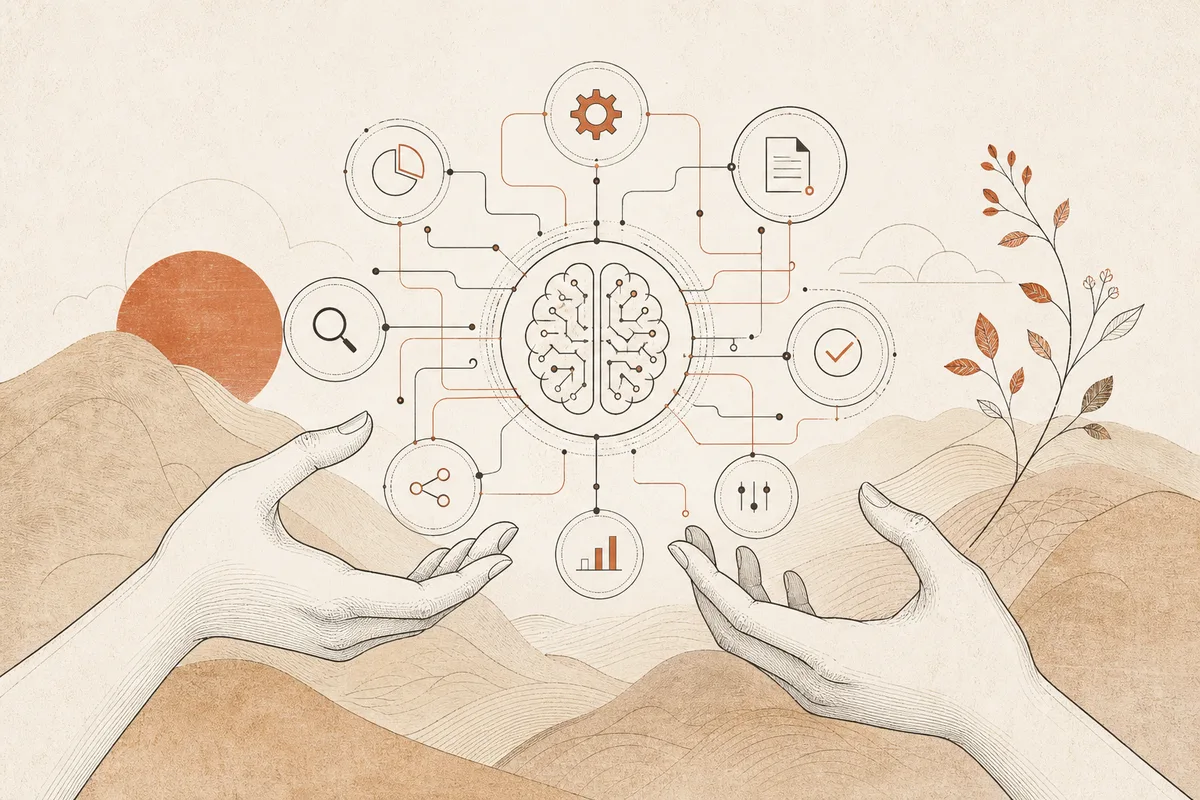
"AI agents" sound like science fiction. In 2026, they're closer to capable interns with access to your tools — useful, fast, and dangerous without guardrails.
Agentic AI goes beyond a chat window. These systems can plan steps, call APIs, read files, trigger workflows, and work across platforms — Slack, email, CRM, project tools — with minimal human prompting. For Quebec SMBs and professional firms, that's both an opportunity and a governance challenge.
After years helping organizations adopt automation progressively, here's how I explain agents to executives who need clarity, not hype.
At a glance
- Agents = AI that takes multi-step actions using tools, not just text replies
- Best fit today: internal workflows with clear boundaries — not unsupervised client-facing decisions
- Guardrails matter more than model choice: permissions, logging, human approval gates
- Start with one bounded workflow; measure before adding autonomy
- Related: context and business data, human-in-the-loop
What makes an agent different from a chatbot
A chatbot answers questions. An agent can:
- Break a goal into steps ("research this vendor, compare pricing, draft a summary")
- Use connected tools (calendar, documents, ticketing, databases)
- Iterate when something fails ("that API returned an error — try another approach")
- Hand off to a human when confidence is low or rules require it
Think of it as a digital coworker with narrow skills and broad reach — if you give it keys to the house, it will use them.
Where agents help SMBs today
| Use case | Why it fits | Caution |
|---|---|---|
| Internal research and synthesis | Bounded data, human reviews output | Don't connect to client PII without governance |
| Ticket triage and routing | Clear rules, measurable accuracy | Escalation path must be explicit |
| Report assembly from multiple sources | Saves hours of copy-paste | Validate numbers and sources |
| Cross-platform notifications | Reduces manual status updates | Avoid alert fatigue |
These aren't replacements for judgment on contracts, hiring, or client advice. They're accelerators for work that was already mechanical — when structured properly.
The cross-platform reality
Modern work doesn't live in one app. Agents shine when they can:
- Pull context from a shared drive or knowledge base (RAG)
- Update a project board after a meeting
- Draft a follow-up email from CRM notes
- Log actions for audit
That integration is powerful — and it's where data safety questions get real. Every connector is a permission. Every action should be traceable.
Guardrails before autonomy
Before any agent pilot, define:
- Scope — Which systems can it touch? Read-only vs write?
- Data class — Green/yellow/red (governance framework)
- Approval gates — What requires human sign-off before send or commit?
- Logging — Who did what, when, with which inputs?
- Kill switch — How do you stop a runaway workflow in minutes?
Agents without guardrails are shadow IT with ambition. I've seen well-meaning teams connect consumer tools to production data — the fix isn't "smarter AI," it's clear policy.
A practical pilot shape
Follow the same discipline as progressive AI adoption:
- Pick one internal workflow (e.g., weekly ops summary from three sources)
- Run parallel with the manual process for 4–6 weeks
- Measure time, error rate, and team satisfaction
- Expand permissions only after proof — not before
Autonomy is a dial, not a switch. Most SMBs should start at high human oversight and loosen gradually.
What to avoid in v1
- Client-facing sends with no review
- Financial transactions or contract changes without dual control
- "Let it figure out our entire process" scope
- Mixing personal and enterprise accounts on the same agent
Bottom line
Autonomous AI agents aren't magic coworkers. They're tool-using workflows that need the same respect you'd give a new hire: clear job description, limited access, supervision, and feedback.
If you're exploring agents for your organization, let's talk about one bounded workflow — not a platform overhaul.