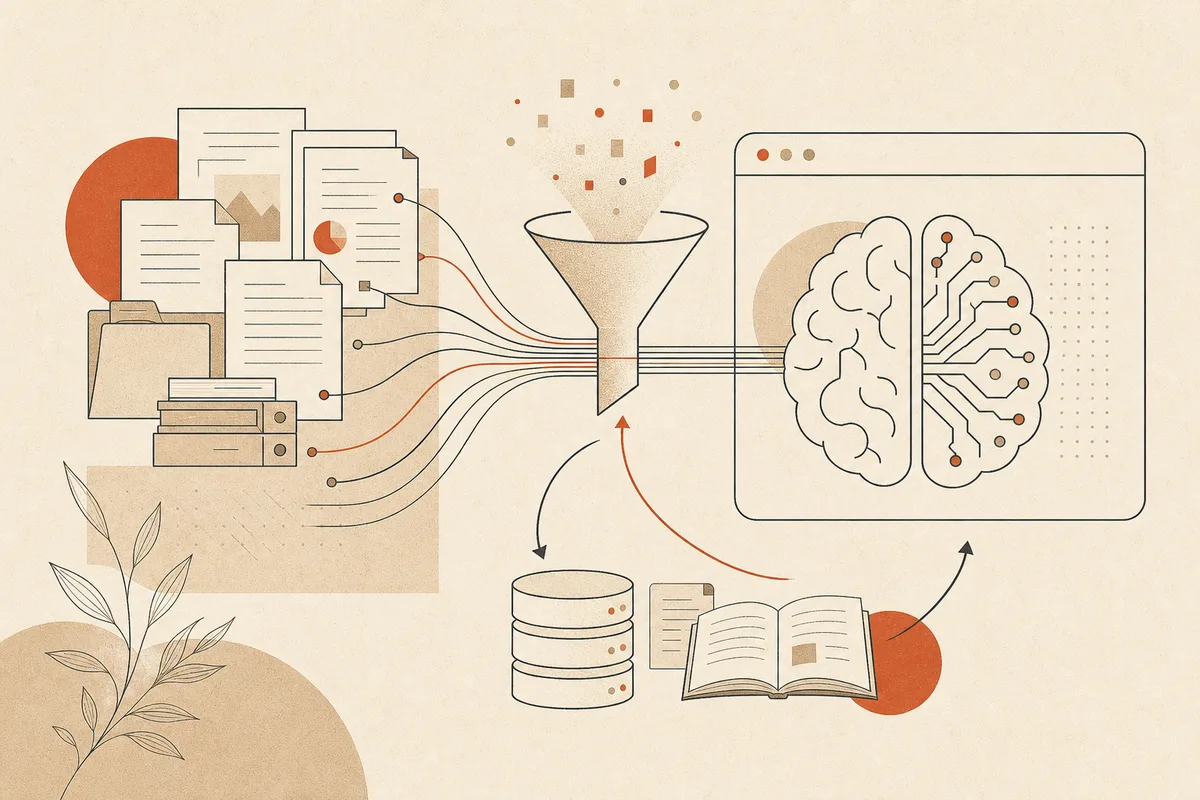
Ask a generic AI about your business and you'll get generic advice. The gap isn't intelligence — it's context.
Every leader who's pasted a company question into a public chat tool has felt it: plausible, fluent, wrong for your reality. Context windows, retrieval (RAG), and your own business data are how AI becomes useful — and how you stay accountable. This is the technical topic I explain most often to non-technical executives.
At a glance
- Context window = how much text the model can "see" in one request (limits apply)
- RAG (retrieval-augmented generation) = fetch relevant docs from your corpus, then generate an answer
- Without curated data, AI guesses from public training — risky for operations and compliance
- Context strategy connects to governance and data safety
Why context windows matter
Models process a finite amount of text per call — policies, emails, manuals, chat history all compete for space. When you exceed limits, something gets truncated — often silently.
| Symptom | Likely cause |
|---|---|
| Answer ignores part of your upload | Truncation or poor prioritization |
| Inconsistent answers same day | Different chunks retrieved or session drift |
| "Forgot" earlier instructions | Window filled; earlier context dropped |
Practical rule: send what matters for this task, not everything you have. Summarize long material; link to canonical sources.
RAG in plain language
Retrieval-augmented generation means:
- User asks a question
- System searches your approved knowledge base (policies, wikis, project files)
- Top relevant passages are injected into the prompt
- Model answers using those passages — ideally with citations
Done well, RAG turns AI from "smart stranger" into "well-briefed colleague." Done poorly, it retrieves wrong chunks and confidently misquotes your own policies.
Building the corpus is operational work — see company knowledge bases.
Business data: the asset and the risk
Your data is why AI could be valuable for you specifically:
- Pricing history, SOPs, past proposals, ticket resolutions
- Meeting archives, inspection templates, regulatory checklists
It's also why privacy and security matter. Classify before indexing:
- Green — internal, low sensitivity, good for early RAG
- Yellow — personal or confidential — strict access and logging
- Red — excluded until legal and security sign off
Never index "everything in the drive" as v1.
Context for agents and workflows
Autonomous agents multiply context needs — they pull from CRM, email, and tools in one run. Without:
- Clear source of truth per data type
- Permissions matching human roles
- Logging of what was retrieved
…agents amplify confusion faster than chat.
How to improve context without a big project
- One canonical folder or wiki for the pilot domain
- Remove duplicates and obsolete versions — RAG hates stale PDFs
- Metadata — owner, date, language (fr/en), status
- Test questions — 20 real queries your team asks weekly; score answers
- Human feedback loop — "wrong doc retrieved" is a product signal, not user error
Context and prompting together
Even with RAG, good prompts specify:
- Which sources to prefer
- What to do if evidence is missing ("say you don't know")
- Output format and review flags
"Use only the provided documents" is a minimum — enforce it in workflow design, not hope.
Bottom line
Context is everything because your competitive advantage is your data and how you work — not the base model everyone shares. Windows, retrieval, and curation turn AI from a party trick into operations.
Related on this site
- Building company knowledge bases for RAG
- Is our data safe with AI?
- Autonomous AI agents and workflows
If answers from AI feel generic for your organization, let's talk about context design before buying another tool.