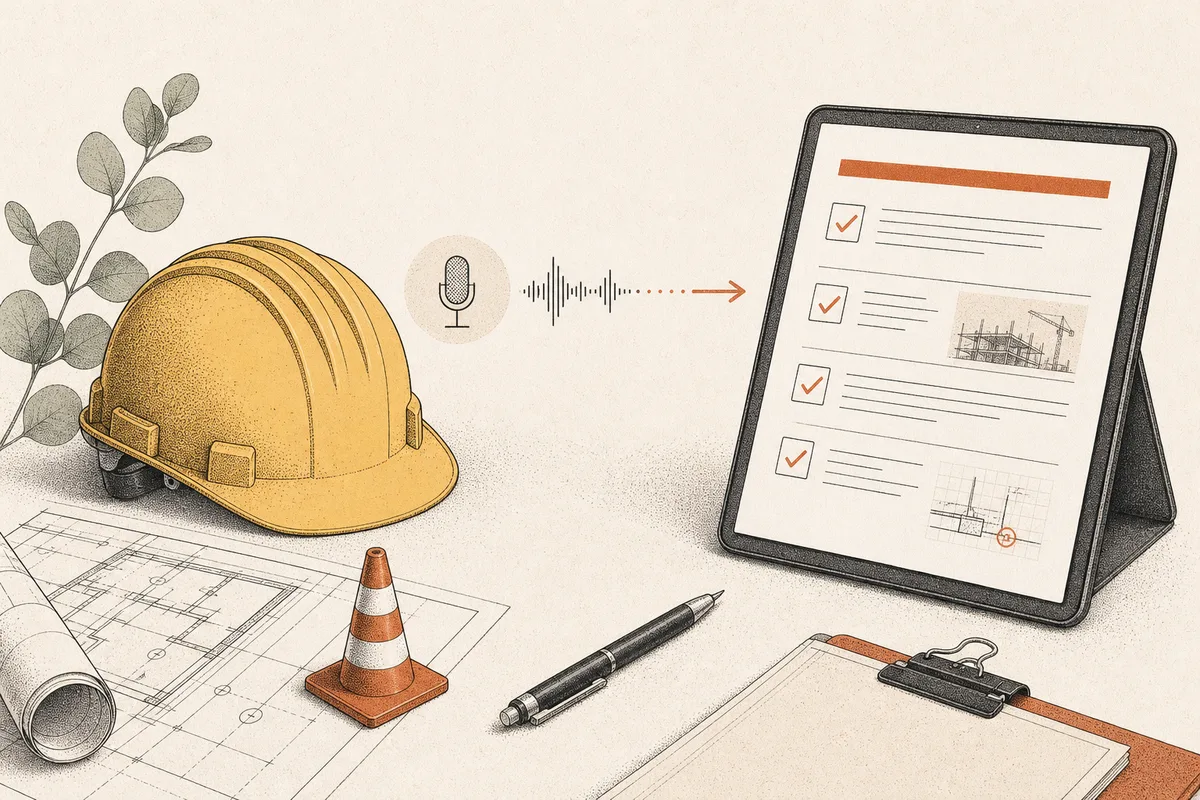
Editorial path — 4 · Concrete pilots · Part 2/3
From field to structured report — full workflow with human validation.
A construction manager finishes a 25-minute site walk. The decisions were clear in the moment. Two hours later, half of them live only in memory — and the report is still blank.
This is not a story about buying another app. It is about a Construction AI Field Assistant workflow: turning what was said on site into a structured report your leadership team can act on — without losing accuracy or accountability along the way.
At a glance
- Site meetings are fast, informal, and verbal; reports must be precise and traceable
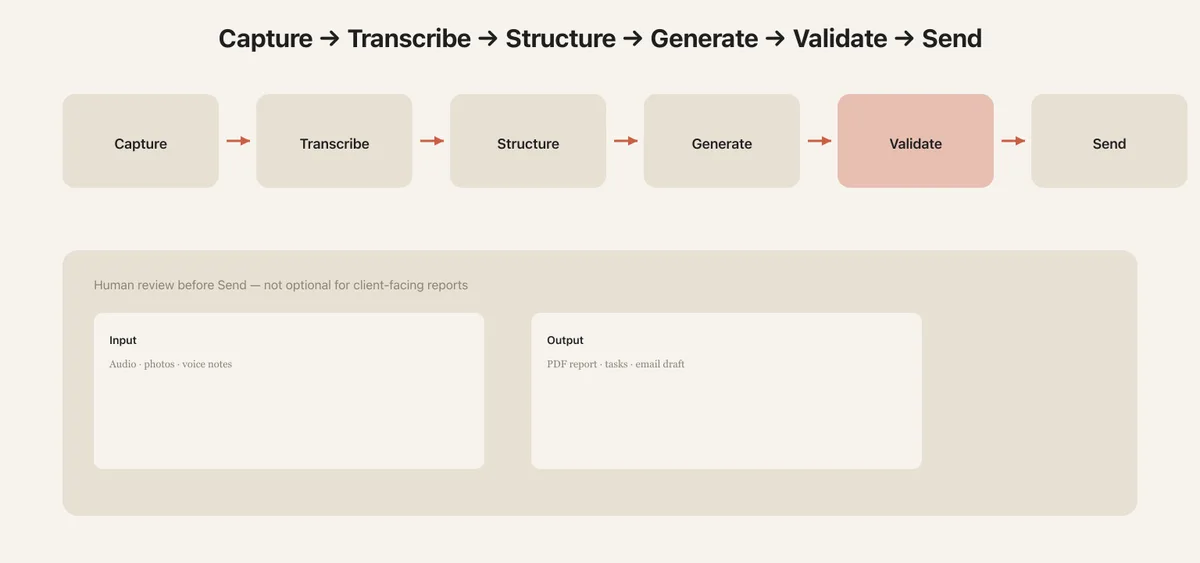
- Useful AI here is Capture → Transcribe → Structure → Generate → Validate → Send — not passive note-taking
- Human approval before anything goes to the client or the owner is non-negotiable
- Measured pilots: 30–50% less drafting time, reports filed same day in most cases
The daily reality
On a typical week, a site lead might attend:
- Short coordination huddles at the trailer
- Informal walkthroughs with trades
- Owner or consultant updates
- Decision meetings about schedule, RFIs, or deficiencies
Discussions happen standing up, in noise, with interruptions. Someone mentions a delay. Someone else assigns a follow-up verbally. A photo gets taken on a phone but never attached to the right thread.
By evening, the expectation is a structured site visit report: what was discussed, issues raised, decisions made, tasks, owners, due dates, risks, photos, next steps. Decision-makers who were not on site depend on it. So do your own teams three days later when memory fades.
Why site reporting is painful
| Pain point | What happens in practice |
|---|---|
| Meetings happen quickly | Key details never get captured |
| Discussions are informal | Tone and nuance are hard to reconstruct |
| Decisions are verbal | "We agreed to…" disputes appear later |
| Tasks spread across people | No single list of who owes what |
| Reports must be accurate | Liability and trust depend on it |
| Writing takes too long | Reports slip to evenings or next week |
| Delays create confusion | Trades mobilize on outdated information |
The cost is not only hours. It is forgotten actions, slow escalation, and weak project history when disputes or claims arise.
The AI workflow (more than note-taking)
Generic transcription gives you words. A field assistant workflow gives you project documentation.
Capture
Record the meeting or walk (with consent), capture voice notes after leaving the trailer, attach site photos with a timestamp or location tag.
Transcribe
Speech-to-text converts audio into searchable text. Quality varies with wind, accents, and overlapping speakers — expect to fix names and trade terms.
Structure
AI maps content to your template: summary, decisions, deficiencies, action table, risks, open questions — not a wall of transcript.
Generate
A draft report, task list, and optional follow-up email in your format (PDF sections, bullet tables, owner-facing language).
Validate
A qualified person reads, corrects facts, confirms decisions, and approves what leaves the organization.
Send
Distribution by email, Teams, or document management — only after approval.
This is operational workflow design, not a chatbot experiment.
Example scenario: schedule, electrical, material, safety
Raw conversation (simplified excerpt):
"We're three days behind on Level 3 because the electrical sub didn't have the conduit spec confirmed… Marie said she can reorder but delivery is Tuesday earliest… We need a temp barrier at the north stair — Jean will handle Monday… Owner wants a written summary by tomorrow, not just verbal… Photo the panel room before close-out."
Structured output (after AI + template + human edit):
| Section | Content |
|---|---|
| Summary | Level 3 schedule delay (~3 days). Root cause: delayed conduit spec confirmation. Electrical reorder in progress; material ETA Tuesday. Temporary safety barrier required at north stair. Owner requests written report by EOD tomorrow. |
| Decisions | Proceed with alternate routing for conduit on east corridor pending Tuesday delivery. Install temp barrier before Monday shift. |
| Action items | Marie — confirm reorder + delivery window — Due Fri — Electrical sub · Jean — install temp barrier — Due Mon — GC · Alain — send approved report to owner — Due Tue 10:00 |
| Risks | Further slip if material not on site Tuesday; panel room close-out blocked until photo documentation complete. |
| Open questions | Final spec revision signed by engineer of record? |
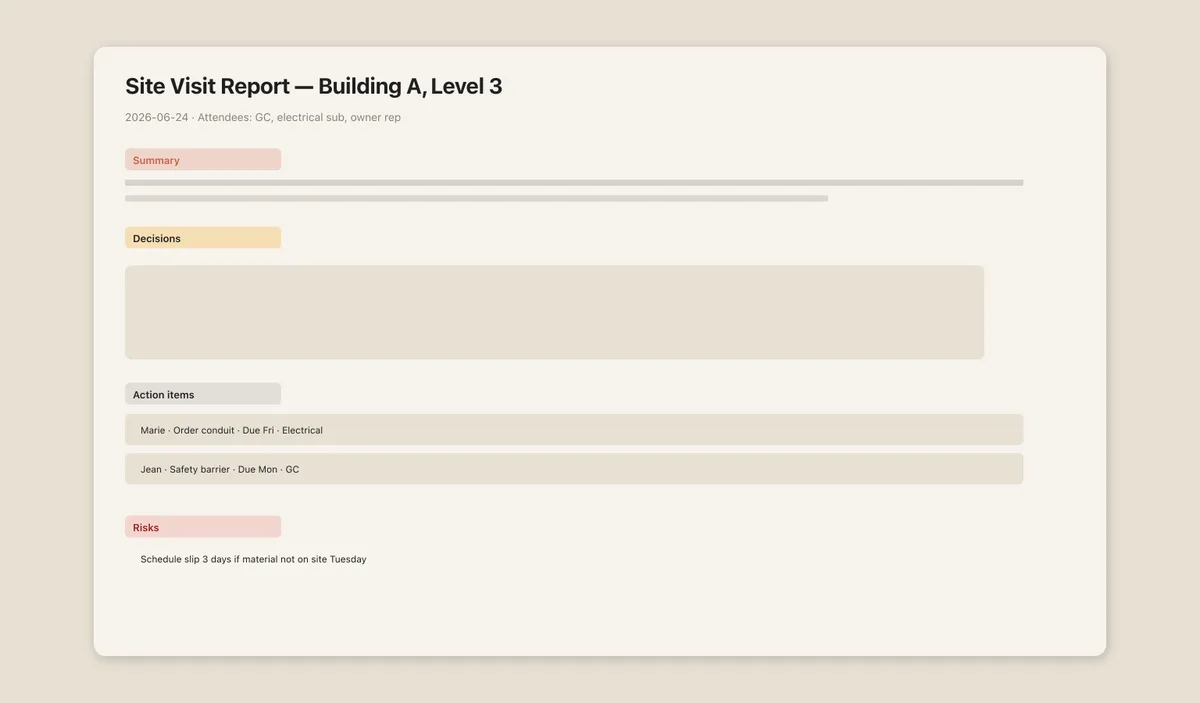
The value is not magic. It is consistent structure from messy input — with a human confirming names, dates, and decisions before send.
Measurable results from a field pilot
In a pilot with a general contractor (4 site leads, 3 active projects), the team compared manual workflow to Capture → Validate over six weeks:
| Metric | Before | After 6 weeks |
|---|---|---|
| Average time visit → approved report | 78 minutes | 34 minutes (−56%) |
| Reports filed same day | 41% | 88% |
| Action items without named owner | 2.1 per report | 0.2 per report |
| Reports pushed to day +3 or later | 38% | 6% |
Human validation time stayed steady (about 12 minutes) — most gains came from automatic structuring and a fixed template. No auto-send to the owner: every report passed through the site lead or project manager.
Implementation: three maturity levels
Level 1 — Simple manual workflow
Record audio on phone → upload to approved transcription tool → paste transcript + template into AI → human edits → PDF/email. Good for: proving value on one project type in 2–3 weeks.
Level 2 — Semi-automated workflow
Mobile form + audio upload + predefined template + generated report in SharePoint or Procore folder. Good for: multiple site leads, repeatable format, basic audit trail.
Level 3 — Full AI Field Assistant
Mobile app: record, photos, templates, task extraction, PDF generation, email/Teams hooks, approval workflow, searchable project history. Good for: high visit frequency, owner reporting obligations.
Move up levels when volume and risk justify investment — not because the vendor demo looked impressive.
Risks and considerations
| Topic | Practical response |
|---|---|
| Consent to record | Announce at start; policy for subs and owners |
| Confidentiality | Approved tools only; no public chatbots with project details |
| Transcription accuracy | Review trade terms; bilingual FR/EN meetings need language settings |
| Human approval | Named approver; no auto-send to external parties |
In Quebec, French and English on the same site are common. Plan for language in capture and output, not just UI labels.
Where you are
You've just seen the second concrete pilot — from field to structured report, with human validation. Next in Concrete pilots: Measuring AI ROI: metrics that convince skeptics, to quantify whether these gains justify scaling.
If your teams spend evenings rebuilding what already happened on site, book a short conversation to map a realistic first pilot for your context.