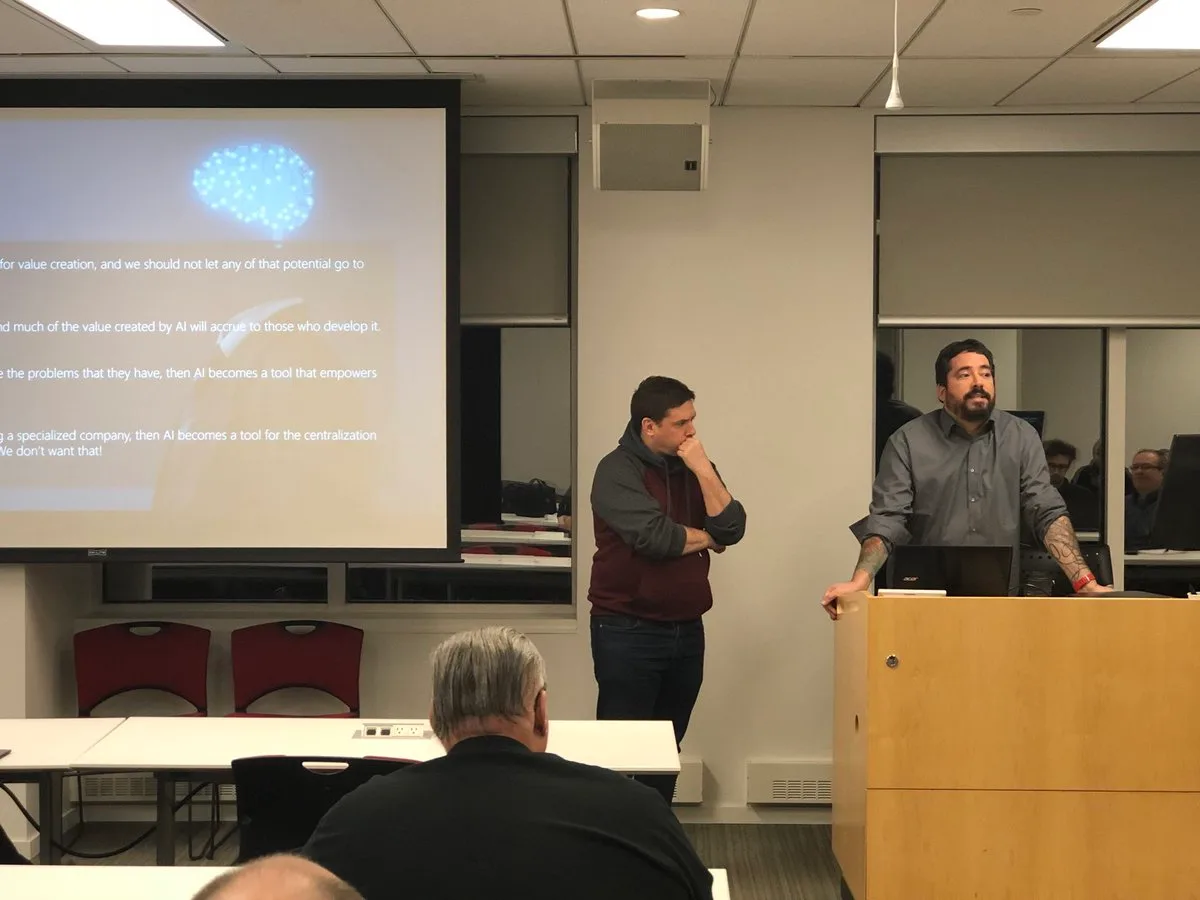
In 2018, I gave my first conference talk on AI to the Azure Montréal user group — a snapshot of a moment before the generative AI wave reshaped everything.
Yesterday was my first experience as a speaker. The Azure Montréal user group invited me to talk about AI and its stakes. Looking back from 2026, much of what I predicted about investment and democratization came true — but the how changed dramatically with large language models, copilots, and tools that didn't exist when I stood at that podium.
This post preserves that moment. For how I advise organizations today, see progressive AI adoption for SMBs.
At a glance
- 2018 marked a burst in AI investment — especially in Montréal's research ecosystem.
- Microsoft Cognitive Services made AI integration accessible with minimal code — a preview of democratization.
- The talk predicted broader AI adoption; LLMs accelerated that timeline beyond what most expected.
- The human-first lesson holds: start with concrete use cases, not hype cycles.
Key takeaways from the 2018 talk
- 2018 would show a burst in AI investment — especially for Montréal. The future looked promising for developers, and the ecosystem delivered.
- Integrating AI in applications was becoming easy — often with only a few clicks using Microsoft Cognitive Services (vision, speech, language APIs).
- 2018 marked the beginning of AI democratization — moving AI from research labs toward everyday applications.

What changed since 2018
| Then (2018) | Now (2026) |
|---|---|
| Cognitive Services APIs for specific tasks | LLMs and copilots for open-ended language work |
| Custom models required more ML expertise | Fine-tuning and RAG accessible to smaller teams |
| AI projects often R&D-led | AI pilots start from operations pain points (meeting notes, document processing) |
| Democratization via cloud APIs | Democratization via chat interfaces and embedded assistants |
The through-line in my work hasn't changed: progressive adoption, human validation, operations first. The tools got faster; the discipline didn't get optional.
Related on this site
Exploring AI for your organization in 2026? Let's talk about one concrete use case — not a replay of 2018 hype.