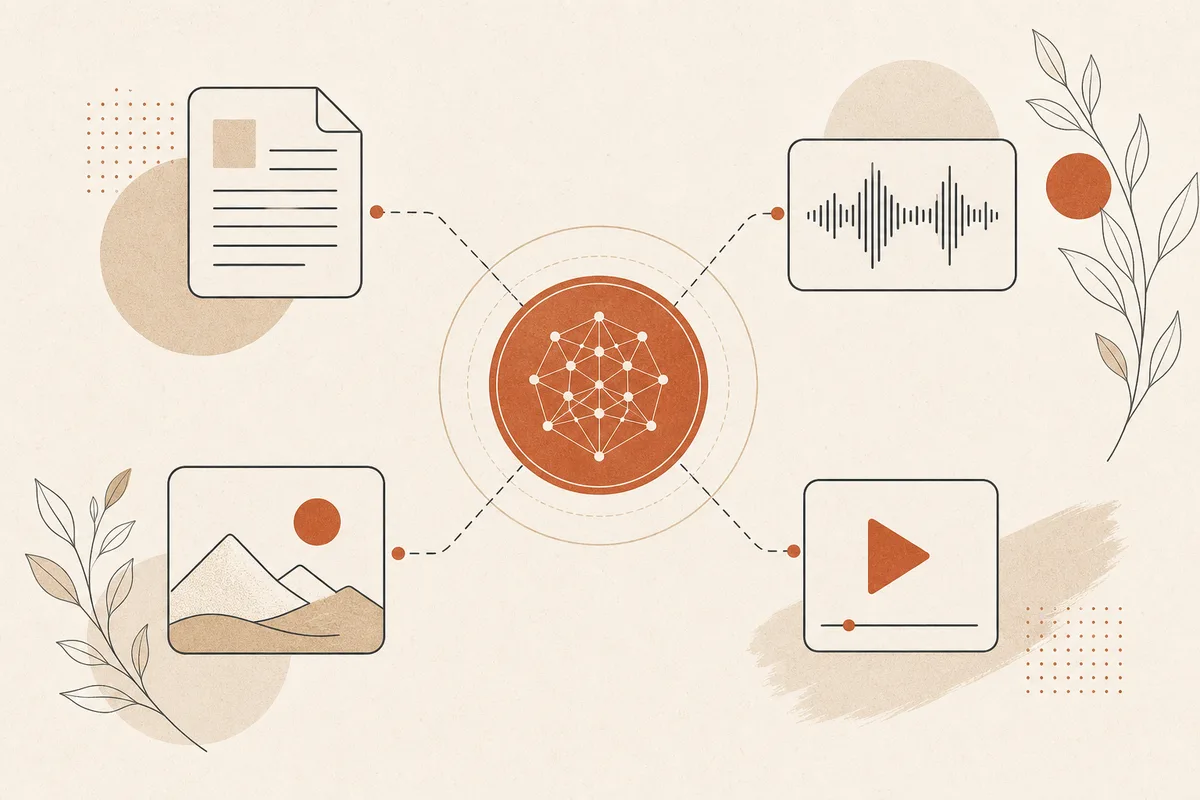
Text-only AI was the first wave. The next is multimodal — systems that understand and produce text, images, audio, and video in the same workflow.
For Quebec organizations, that shift matters beyond demos. A field photo, a voice memo, a scanned invoice, and a spreadsheet can feed one analysis. Used well, multimodal AI removes friction in inspection, documentation, and client service. Used carelessly, it multiplies privacy and quality risks.
At a glance
- Multimodal = one model or pipeline handling several input/output types together
- Strong SMB use cases: transcription, document capture, visual inspection support, rich meeting summaries
- French and English inputs both matter in Quebec — test quality in your working language
- Always validate outputs; vision and audio models hallucinate differently than text-only chat
What "multimodal" means in practice
Instead of chaining five separate tools, a multimodal system can:
- Transcribe a meeting recording and extract action items (meeting notes pilot)
- Read a photo of equipment damage and draft an inspection note
- Parse a PDF invoice and compare it to a purchase order
- Generate a summary that references both slides and spoken Q&A
The value isn't novelty — it's fewer handoffs between formats.
Use cases worth exploring
| Modality mix | Business example | Pilot tip |
|---|---|---|
| Audio → text | Client calls, site visits, board meetings | Human validates before CRM update |
| Image + text | Quality checks, inventory, insurance photos | Define what the model is allowed to infer |
| Document + text | Contracts, RFPs, regulatory filings | Use RAG on your corpus, not generic upload |
| Video → summary | Training, safety briefings | Check retention and consent (Law 25) |
Start where the input already exists — recordings, photos, PDFs — not where you'd need new hardware or culture change overnight.
Quebec-specific considerations
- Language: Test French (fr-CA) and English separately. Accent, domain jargon, and code-switching affect accuracy.
- Law 25: Audio and images often contain personal information. Document purpose, retention, and who can access outputs (data safety).
- Professional liability: In legal, accounting, or engineering contexts, multimodal drafts are starting points — not deliverables.
Risks that differ from text-only AI
- Misread visuals — glare, blur, or ambiguous damage in a photo
- Transcription errors — names, numbers, and negation ("not approved" vs "approved")
- Over-trust — a polished summary hides a wrong detail from the source audio
- Larger payloads — more data moving through pipelines; tighter governance required
A sensible pilot
- One modality pair (e.g., audio → structured notes)
- Enterprise tool with Canadian or approved hosting where required
- Side-by-side with human notes for 20–30 samples
- Score: accuracy, edit time, and user trust — not just "wow factor"
Prompting across modalities
Good prompting discipline still applies: specify role, output format, what to ignore, and what requires flagging. For images, describe what to look for and what not to guess.
Bottom line
Multimodal AI is most valuable when it connects formats your team already juggles — not when it adds a new channel nobody asked for.
Related on this site
If you're weighing audio, image, or document AI for a specific workflow, let's talk about a bounded pilot with clear validation rules.